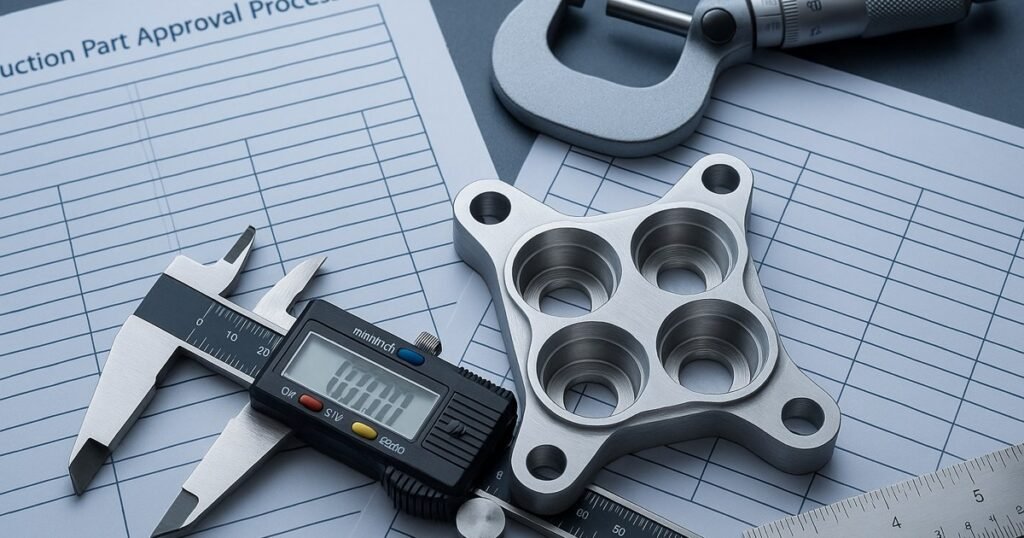
APQP (Advanced Product Quality Planning) is a structured process for taking a new product from concept to production while building quality in at every stage, rather than inspecting it in at the end. It ties tools like DFMEA, PFMEA, control plans and PPAP into one coherent plan.
When a launch goes badly, it is rarely a lack of tools. It is that the tools were disconnected. APQP exists to connect them, and it is the single biggest lever a supplier has for a clean, on-time launch.
Key takeaways
- APQP is a 5-phase plan from concept to production.
- PPAP is one output within APQP, not a separate process.
- AS9145 applies APQP and PPAP to aerospace.
- Phase-gate reviews keep APQP honest.
What is APQP?
APQP assigns quality activities across the life of a program so the right work happens at the right time and nothing important is discovered at the last minute. It began in automotive and is applied to aerospace through AS9145 and to automotive through IATF 16949.
The 5 phases of APQP
- Plan and define the program from the customer’s requirements.
- Product design and development, completing the DFMEA.
- Process design and development, completing the PFMEA and control plan.
- Product and process validation, including PPAP.
- Launch, feedback and continuous improvement.
APQP vs PPAP
They are not the same. APQP is the overall planning process; PPAP (Production Part Approval Process) is a specific output within it that approves the part for production. You run APQP; you submit PPAP.
Is APQP part of IATF 16949?
Yes. IATF 16949 expects automotive suppliers to use APQP and PPAP, and AS9145 brings the same discipline to aerospace, pairing directly with AS9100. If a prime contractor has asked for APQP or PPAP deliverables, one of these frameworks is behind the request.
The OQS APQP phase-gate checklist
Most launch problems trace back to a phase that was allowed to close before its outputs were done. At each gate, confirm:
- Gate 1: requirements and special characteristics are agreed.
- Gate 2: the DFMEA is complete and design is stable.
- Gate 3: the PFMEA and control plan are built and linked.
- Gate 4: PPAP is submitted and the process runs at rate.
- Gate 5: lessons learned are captured and fed back.
Hold the gate until its outputs are real, and the launch takes care of itself.
Why APQP matters
A disciplined APQP catches design and process problems while they are still cheap to fix, protects the launch date, and gives the customer confidence that you can deliver at rate. Skipping it does not save time; it simply moves the problems into production, where a change costs far more and often ships to the customer first. In our experience, the suppliers who run APQP as one connected plan, rather than a folder of separate forms, are the ones who launch without drama.
APQP works best as a cross-functional effort. Design, process engineering, quality, purchasing and often the customer each own the outputs closest to their work, so the plan reflects reality rather than one department’s view.
APQP FAQ
What does APQP stand for? Advanced Product Quality Planning.
What is the APQP checklist? A gate-by-gate list of the outputs due in each phase, like the one above.
Does AS9100 require APQP? AS9100 requires planning of product realization, and AS9145 provides the APQP and PPAP method aerospace customers expect.
Is APQP only for automotive? No. It began in automotive, but AS9145 adapts it for aerospace, and the same logic helps any regulated manufacturer.
Launching a new aerospace part?
Optimal Quality Solutions helps aerospace, defense and manufacturing teams build audit-ready quality systems, with a 98% first-time certification success rate and 15+ years of hands-on experience.