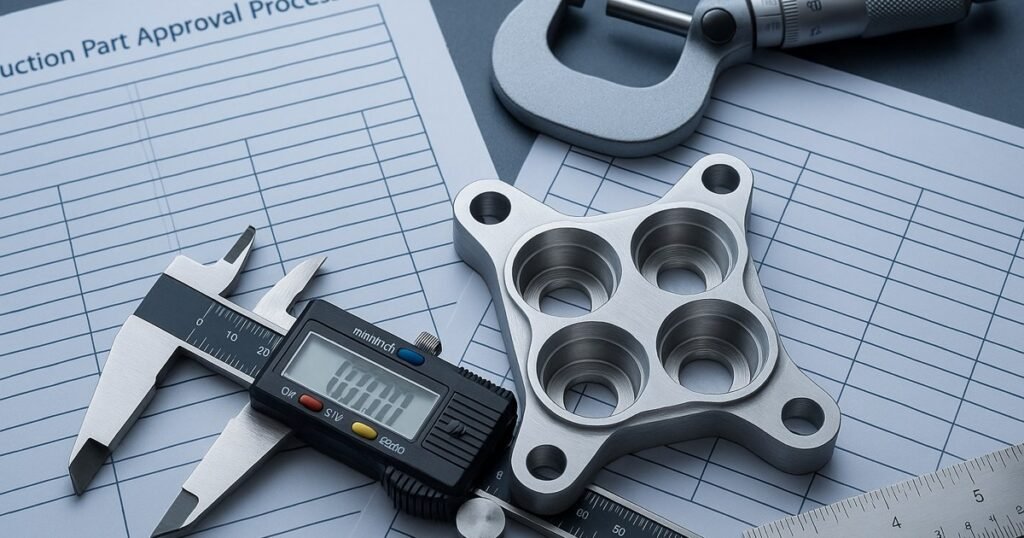
AS9145 is the aerospace standard that defines Advanced Product Quality Planning (APQP) and the Production Part Approval Process (PPAP) for the aviation, space, and defense supply chain. It gives suppliers a five-phase framework for planning quality into a part before production starts, then proving that capability through a documented PPAP submission the customer can approve.
In the systems we build for aerospace and manufacturing clients, AS9145 is where design intent, process control, and first article inspection finally line up. It was published by SAE and the International Aerospace Quality Group to replace a patchwork of customer-specific APQP demands with one common language shared between primes and their suppliers.
Key takeaways
- AS9145 applies APQP and PPAP specifically to aerospace, so quality is planned during design rather than inspected in at the end.
- It defines five APQP phases, each with gate reviews before a program moves forward.
- Core deliverables include the DFMEA, PFMEA, control plan, and First Article Inspection (FAI) per AS9102.
- AS9145 is a method standard that complements the AS9100 quality management system rather than replacing it.
What is the AS9145 standard?
AS9145 is a process standard that tells aerospace suppliers how to plan, develop, and validate a new part or process. Where AS9100 sets the requirements for a quality management system, AS9145 fills in the product realization side with a repeatable method. It answers a practical question a prime keeps asking a supplier: prove that this part will meet drawing and that the process making it is stable and capable.
The standard pulls together two disciplines the automotive world formalized years earlier, APQP and PPAP, and adapts them to the traceability, configuration control, and first article expectations of aviation and defense work. That is why it sits close to Advanced Product Quality Planning and to the wider aerospace toolset our team supports through advanced aerospace standards consulting.
The 5 APQP phases AS9145 requires
AS9145 organizes product development into five phases, each closed by a gate review so problems surface early instead of on the shop floor.
- Planning. Translate customer requirements, drawings, and key characteristics into a program plan, timeline, and quality objectives.
- Product design and development. Complete the design, run the DFMEA, and confirm the design meets functional and reliability needs before releasing it.
- Process design and development. Build the manufacturing process, create the PFMEA and control plan, and define the measurement methods.
- Product and process validation. Run production trials, complete the First Article Inspection, prove process capability, and assemble the PPAP file.
- Ongoing production, use, and post-delivery. Monitor the process, manage changes, and feed lessons learned back into the plan.
Key AS9145 deliverables: DFMEA, PFMEA, control plan and FAI
The phases produce specific records, and auditors and customers look for each one. The Design FMEA (DFMEA) ranks design failure modes and drives design changes before release. The Process FMEA (PFMEA) does the same for the manufacturing process and links directly to the control plan, which lists every characteristic, its control method, and its reaction plan. The First Article Inspection, documented per AS9102, verifies that the first production part matches every drawing and specification requirement.
These deliverables are not paperwork for its own sake. A weak PFMEA usually shows up later as an escape, and a control plan that ignores the key characteristics from the DFMEA leaves the highest-risk features unguarded. Getting the flow right is a core reason suppliers ask for help with AS9145, and it connects to the internal audit and documentation discipline a mature AS9100 system already provides.
AS9145 vs AS9100: how the two standards fit together
Suppliers often ask whether AS9145 replaces AS9100. It does not. One defines the management system, the other defines the product planning method used inside it.
| Aspect | AS9100 | AS9145 |
|---|---|---|
| Purpose | Aerospace quality management system requirements | APQP and PPAP method for product and process |
| Scope | Whole organization and its processes | A specific part, product, or process launch |
| Certification | Certifiable by an accredited body | Applied as a requirement, often flowed down by customers |
| Core outputs | Procedures, audits, management review | DFMEA, PFMEA, control plan, FAI, PPAP file |
In practice an AS9100-certified supplier uses AS9145 as the engine for every new part it launches, so the two reinforce each other.
What are the 5 levels of PPAP?
PPAP submission levels set how much evidence a supplier sends to the customer for approval. The standard uses the same tiered idea familiar from broader PPAP practice.
- Level 1. Part Submission Warrant only, sent to the customer.
- Level 2. Warrant with product samples and limited supporting data.
- Level 3. Warrant with samples and the full supporting data package. This is the most common aerospace default.
- Level 4. Warrant plus whatever specific requirements the customer defines.
- Level 5. Warrant, samples, and the complete records available for review at the supplier site.
The OQS AS9145 readiness checklist
Before you commit to a launch on a live program, we walk clients through five practical checks that catch most of the problems we see in real submissions.
- Key characteristics agreed in writing. Confirm which features are flagged as key or critical with the customer before the DFMEA, not after.
- DFMEA and PFMEA actually linked. Every high-severity design failure mode should trace to a control in the PFMEA and the control plan.
- Measurement capability proven. Run a measurement systems check so gauge error does not mask a real capability problem at FAI.
- FAI planned into the trial run. Schedule the AS9102 First Article against a genuine production run, not a hand-built sample.
- A named PPAP owner. Give one person responsibility for assembling and defending the PPAP file so nothing falls between engineering and quality.
Standards evolve, so verify the current edition and any customer-specific requirements against the official source at SAE International before you finalize a plan.
AS9145 FAQ
What is the difference between AS9145 and AS9100? AS9100 is the certifiable aerospace quality management system standard for your whole organization. AS9145 is the APQP and PPAP method you apply to launch a specific part or process inside that system.
What is the difference between PPAP and APQP? APQP is the planning framework that runs across all five phases of a launch. PPAP is the approval package produced near the end that proves the part and process meet requirements before full production.
Is AS9145 certification required? It is usually flowed down as a contractual requirement by a customer rather than certified on its own. Many primes require suppliers to follow it and submit a PPAP for new or changed parts.
Who needs to follow AS9145? Aerospace, defense, and space suppliers developing new parts or processes, especially those in a supply chain governed by AS9100. If you would like help applying it, our team is a message away through the contact page.
Ready to build an AS9145 APQP and PPAP program that holds up to audit?
Optimal Quality Solutions helps aerospace, defense and manufacturing teams build audit-ready quality systems, with a 98% first-time certification success rate and 15+ years of hands-on experience.